



CUSTOMER COMPLAINTS
We are sorry if we have caused any inconvenience to you. Please fill up the form below with your details. Our customer support staff will make sure we address your issue at the earliest.
If you’re renovating your home or planning a new build, you’ve probably already come across the term uPVC windows and doors more than once. And for good reason — uPVC( unplasticized polyvinyl chloride) has quietly become the go-to material for homeowners who want windows and doors that look good, last long, and don’t demand constant upkeep.
At Durakraft Extrusions , we manufacture a full range of uPVC windows and doors designed for Indian homes and climate conditions — from casement windows to sliding doors, monorail systems, and low threshold options. In this guide, we’ll walk you through our entire product range in simple terms, so you know exactly what to choose for your home.
Before we get into the specific products, it helps to understand why uPVC has become such a popular choice over traditional wood or aluminium.
1. Weather-Proof Performance uPVC windows and doors are built to withstand harsh weather— scorching summers, monsoon rains, and everything in between — without warping, cracking, or fading.
2. Energy Efficient and Eco-Friendly Good uPVC profiles use multi-chamber designs that trap air and act as natural insulators. This means your room stays cooler in summer and warmer in winter, which directly reduces your electricity bills. The material is also recyclable, making it a genuinely eco-friendly choice.
3. Low Maintenance Unlike wood, uPVC doesn’t need painting, polishing, or termite treatment.
A simple wipe-down is usually all it takes to keep it looking new for years.
4. High Security Quality uPVC windows and doors come with multi-point locking systems, giving your home an added layer of protection.
5. Sound Proofing If you live near a busy road or in a noisy neighbourhood, uPVC’s sealed, multi-chamber profile design significantly cuts down outside noise.
6. Thermal Insulation The insulating properties of uPVC keep indoor temperatures more stable, reducing the load on your air conditioning or heating systems.
Now let’s look at how these benefits come to life across Durakraft’s actual product range.
Casement windows are the classic hinge-and-swing style that most Indian homeowners are familiar with, and our DK60 Casement Openable Window range is built around comfort, strength, and style.
This variant opens inward, making it ideal for spaces where outdoor obstructions (like balconies or grills) limit outward swing. It features:
● 60 mm frame depth for sturdy structural support
● Glazing options from 4 mm to 32 mm, so you can choose anything from basic single glazing to advanced double or triple glazing
● A multi-point locking system for enhanced safety
● TPE gaskets for weatherproofing
● Maximum frame height of up to 2000 mm
The outward-opening version of the same series, ideal for maximising usable interior space since the sash swings outward rather than into the room. It shares the same 60 mm frame depth, multi-chamber insulation design, and integrated water drainage system.
Beyond windows, the DK60 platform extends to full casement doors as well. With a sight line of152 mm and support for frame heights up to 2800 mm, this door option is well suited for main entrances, balcony access, and garden-facing openings. Like the window variants, it supports both outward and inward casement operation depending on your requirement.
Best for: Homeowners who want a traditional window and door look with modern performance— bedrooms, living rooms, and balcony doors.
If you’re looking for a sliding option with a single, sleek track, the DK84 Monorail WindowSystem is worth considering. Despite the simple single-track design, it doesn’t compromise on strength or security.
Key specifications include:
● 84 mm monorail frame depth
● Precision-fit aluminium track for a smooth sliding mechanism
● Glass thickness options from 4 mm to 18 mm
● Maximum load capacity between 80 kg and 180 kg
● Maximum frame height of 1800 mm
The multi-chamber design ensures the same insulation and sound-proofing benefits you’d expect from a casement window, but in a track-based sliding format that’s easier to operate in tighter spaces.
Best for: Kitchens, utility areas, and spaces where a single smooth-sliding sash is more practical than a hinged window.
For casement doors specifically, Durakraft also offers:
● Low Threshold for Casement Door (Open In) and Open Out variants, both with a 60mm frame depth and low threshold sight line of 114 mm
● Sash Infill for Casement Door (Open In) and Open Out variants, which offer a solid in fill option instead of a low threshold, for projects where a raised threshold is preferred or requiredBoth options support glazing from 4 mm to 32 mm and frame heights up to 2800 mm, with the same multi-point locking and weatherproofing gaskets found throughout the Prestigia Series.
With so many configurations available, here’s a simple way to think about your choice:
1. Hinged vs. Sliding: Choose casement (DK60) windows and doors if you want maximum ventilation and a classic look. Choose sliding (DK60, DK80, DK108) options if floor space or wide openings are a priority.
2. Track Count: More tracks (2T, 2.5T, 3T) generally mean more panels and often the option to add an insect mesh screen.
3. Standard vs. Eco Series: The Luxuria (Standard) series offers deeper frames and higher glazing capacity for premium performance. The Premia (Eco) series is a practical, cost-effective alternative for secondary spaces.
4. Threshold Needs: If seamless indoor-outdoor flow matters – for a balcony, patio, or accessibility reasons – look at the Prestigia low threshold systems.
uPVC generally offers better thermal insulation than aluminium and requires far less maintenance than wood, while still being durable and secure. The right choice ultimatelydepends on your budget, climate, and aesthetic preference.
Thicker glass (closer to the 18-32 mm range depending on the product) offers better sound insulation and security, while thinner glass is more budget-friendly. Your local climate and noise levels should guide this decision.
Yes — several of Durakraft’s sliding configurations, including the 2.5T and 3T3P systems, aredesigned to accommodate an insect mesh screen alongside the glass panels.
A low threshold door minimizes the raised strip at the base of the door frame, creating a smoother, near-seamless transition between indoor and outdoor flooring. It’s especially use ful for balconies, patios, and homes prioritising accessibility.
Whether you’re looking for a simple casement window for a bedroom, a wide sliding door for your balcony, or a barrier-free low threshold system for a modern patio, Durakraft’s product range covers nearly every uPVC windows and doors requirement for Indian homes. Each product is built around the same core promise: weatherproof performance, energy efficiency, low maintenance, and lasting security.
To explore the full product range, get technical specifications, or request a quote, visit Durakraft Extrusions or reach out to our team directly.
Follow us on Instagram – Durakraft Extrusions
uPVC Windows vs Old Windows: When Should You Upgrade?
Top 10 uPVC Windows and Doors Profile Manufacturers in India
Best Modern uPVC Doors and Window Designs in 2026
uPVC vs Wood Windows and Doors: Why uPVC Is the More Practical Choice for Most Modern Homes
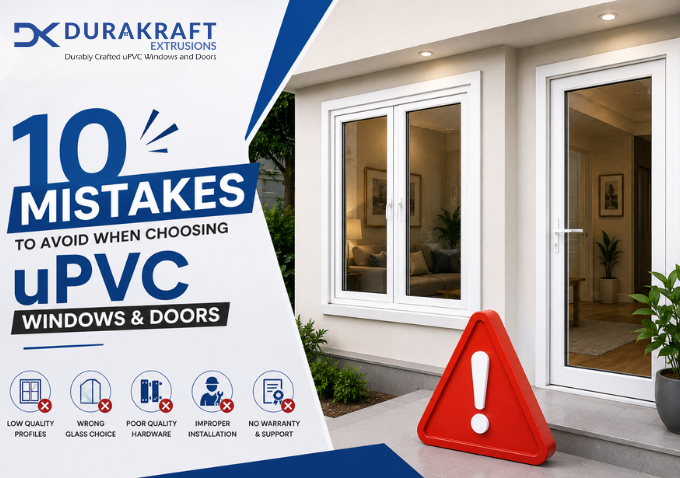
10 Mistakes to Avoid When Choosing uPVC Windows and Doors
uPVC Building Materials: A Complete Guide to Modern Home Solutions
Best uPVC Windows and Doors in India: How to Choose the Right Manufacturer
uPVC Frames Buying Guide: How to Choose the Right uPVC Window and Door Frames
How to Choose the Best uPVC Door and Window for Your Home
How to Choose the Right Sound Resistant uPVC Windows and Frames
Copyright 2025 All Rights Reserved, Durakraft | Site Designed by CITEC