




CUSTOMER COMPLAINTS
We are sorry if we have caused any inconvenience to you. Please fill up the form below with your details. Our customer support staff will make sure we address your issue at the earliest.
Choosing new windows and doors is a long-term decision. The right system can make a home more comfortable, secure, quieter, and easier to maintain. However, many buyers focus only on the design or quoted price and miss the technical details that affect everyday performance.
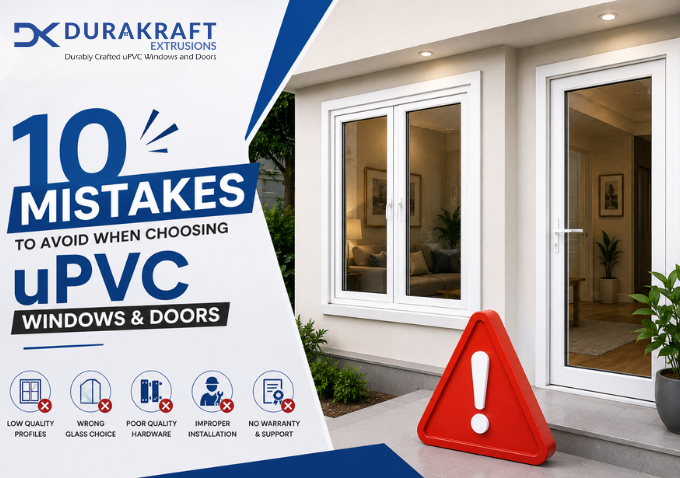
This guide explains 10 common mistakes to avoid when choosing uPVC windows and doors. You will learn what to check in the profile, glass, reinforcement, hardware, installation, price, manufacturer, and warranty before placing an order.
Quick answer: The most common mistakes are choosing only by appearance or price, ignoring profile quality, selecting the wrong glass or system, overlooking reinforcement and installation, and failing to check the manufacturer’s technical support and warranty.
Before comparing quotations, check these eight points:
| Check | Why it matters |
| Profile quality | The profile forms the main frame of the system. |
| Window or door type | Casement, sliding, French, tilt-and-turn, and slide-and-fold systems suit different spaces. |
| Glass and glazing | Glass affects heat, daylight, safety, and noise performance. |
| Reinforcement | Larger or heavier openings may need suitable reinforcement. |
| Hardware and seals | Handles, locks, rollers, hinges, gaskets, and seals affect operation and protection. |
| Fabrication and installation | Poor workmanship can reduce the performance of a good product. |
| Manufacturer support | Technical drawings, product guidance, and complaint support can prevent expensive problems. |
| Warranty and price | A clear warranty helps you compare the real value of different quotations. |
The following mistakes explain each point in simple language.
A beautiful sample is a good starting point, but it is not enough to judge quality. Two windows can look similar while having different profile dimensions, reinforcement capacity, hardware, seals, glass, and fabrication quality.
Before choosing a colour or design, ask how the system will perform in your room. Does the opening need more ventilation? Is the window exposed to strong sunlight, rain, dust, or outside noise? Will the door be used several times a day? Does the opening require a wide view or better security?
The best uPVC windows are not automatically the most decorative ones. They are the ones that match the building, opening size, climate, usage, and performance needs.
What to do instead: Ask for a product specification, profile cross-section, available glass options, hardware details, and examples of similar installations.
Price is important, especially when you are renovating a home or planning a large project. However, the lowest quotation may not include the same quality of glass, reinforcement, hardware, seals, fabrication, installation, or after-sales support as a higher quotation.
When comparing the uPVC windows and doors price or uPVC door price, check exactly what is included. A quotation should ideally explain the profile series, window or door type, dimensions, glass, hardware, colour or finish, reinforcement, installation, taxes, transport, and warranty.
A low initial price can become expensive if the system needs repairs, replacement parts, repeated adjustments, or reinstallation. The right comparison is not simply “Which quote is cheapest?” It is “What performance and service am I receiving for this price?”
What to do instead: Compare complete specifications line by line. Ask for a written explanation whenever two quotations show a large price difference.
The profile is more than a plastic frame. It is an engineered component with chambers, walls, drainage paths, reinforcement spaces, glazing pockets, and connection points. Its design must be suitable for the intended application.
When checking uPVC windows and doors profiles, ask about the profile series, dimensions, intended use, material formulation, reinforcement compatibility, glazing range, and available accessories. Do not judge the profile only by its colour, surface finish, or number of chambers.
A profile designed for a small residential window may not be the right choice for a large sliding door or a wide balcony opening. The manufacturer or fabricator should help match the system to the opening and expected load.
What to do instead: Request technical drawings and ask which profile series is recommended for your particular window or door size.
A window is not just a frame. A complete uPVC windows and doors system includes the profile, glass, reinforcement, hardware, gaskets, seals, fabrication, drainage, and installation. A uPVC windows and doors system also needs suitable hinges, locks, handles, thresholds, reinforcement, and glass for the type of use.
If one component is poorly matched, the final result may not perform as expected. For example, a strong frame with unsuitable hardware may be difficult to operate. Good glass cannot compensate for poor sealing. A high-quality profile may still underperform if it is fabricated or installed incorrectly.
What to do instead: Evaluate the complete assembly rather than choosing a profile in isolation. Ask who is responsible for design, fabrication, installation, and post-installation service.
Glass has a major effect on comfort and safety. The correct choice depends on the room, orientation, climate, opening size, security needs, and budget.
Single glazing, double glazing, toughened glass, laminated glass, and acoustic glazing serve different purposes. Double glazing may help reduce heat transfer, while laminated glass may be preferred where safety or sound control is important. However, the final result also depends on the frame, seals, installation, and the surrounding building.
For a bedroom facing a busy road, ask about the complete acoustic solution rather than asking only for a “soundproof window” For a sunny room, ask how the glass and window orientation affect heat and glare. For a large door, ask whether the selected glass is suitable for the size and hardware.
What to do instead: Choose the glass after discussing the room’s real requirements. Ask the supplier to explain the expected benefit and any limitations in plain language.
Large windows and doors may need suitable reinforcement to improve stability and support heavier glass and hardware. The correct solution depends on the profile design, opening dimensions, wind exposure, glass weight, and application.
Hardware is equally important. Handles, locks, rollers, hinges, gaskets, and accessories should be compatible with the selected system. Mixing components from different systems without technical approval can create alignment, sealing, operation, or service problems.
What to do instead: Ask for the recommended reinforcement specification and hardware list for each opening. For larger projects, request technical drawings and fabrication guidance before production begins.
Even a high-quality product can perform poorly when it is measured, fabricated, transported, or installed incorrectly. Common problems may include misalignment, difficult operation, water leakage, air gaps, damaged seals, poor drainage, or loose hardware.
Installation is especially important for large windows, balcony doors, sliding systems, and projects with many openings. The installer must understand the profile system, fixing method, drainage, sealing, frame alignment, glass fitting, and hardware adjustment.
What to do instead: Ask who will take the measurements, fabricate the units, install them, and handle complaints. Request photographs or references from similar projects. Confirm whether the installation team has experience with the selected system.
There is no single window or door style that is best for every room. The right choice depends on the available space, ventilation, opening size, view, operation, security, and design preference.
Casement windows can be suitable when wide ventilation and a clear opening are important. Sliding windows can work well where the shutters need to move within the frame. Tilt-and-turn windows offer different opening positions. French doors can suit wider entrances, while slide-and-fold systems are often considered for large openings where a wider connection to an outdoor area is desired.
The key is to select the system based on the room rather than following a trend. A stylish design may be inconvenient if it blocks furniture, reduces ventilation, or requires more space than the room allows.
What to do instead: Prepare a room-by-room opening schedule. Note the dimensions, direction of opening, ventilation requirement, expected usage, glass preference, and available space.
The manufacturer influences more than the appearance of the final product. A reliable uPVC window manufacturer or profile supplier should be able to provide clear information about profile systems, applications, technical specifications, quality procedures, product availability, and support.
Before choosing a company, check its manufacturing experience, product range, factory or business information, certificates, technical documents, fabricator network, delivery capability, and complaint process. If you are a builder, architect, contractor, or fabricator, also ask whether the company provides profile drawings, fabrication guidance, reinforcement recommendations, and technical assistance.
Be careful with vague claims such as “best,” “premium,” or “number one.” Ask what those claims are based on. A trustworthy supplier should explain the product in measurable and understandable terms.
What to do instead: Prepare a short manufacturer checklist and ask the same questions to every shortlisted supplier. This makes the comparison more objective.
A warranty is useful only when its coverage and process are clear. Before buying, ask what is covered, how long the coverage lasts, which components are included, what exclusions apply, and how a complaint is registered.
Also ask whether the company provides replacement parts, technical assistance, service visits, or support through the fabricator. Keep the quotation, drawings, product specifications, invoice, warranty document, and installation details safely after purchase.
Good after-sales support is particularly important for large projects or products with multiple components. It can help resolve questions about hardware adjustment, replacement parts, seals, drainage, and future maintenance.
What to do instead: Do not accept a verbal promise as a warranty. Request the terms in writing and confirm who will be your service contact.
Use this checklist when comparing uPVC windows and doors:
If you can answer these questions confidently, you are much less likely to face avoidable problems later.
Start with the building and the opening, not with a catalogue picture. Measure the space correctly and identify the main requirement: ventilation, daylight, security, heat control, noise reduction, design, or ease of operation.
Next, compare complete systems. Review the profile, glass, reinforcement, hardware, seals, fabrication, installation, warranty, and technical support together. Then compare quotations only after confirming that each supplier is offering a similar specification.
Finally, choose a manufacturer and installer who can explain the product clearly. A good buying experience should not depend on confusing technical language or pressure to make a quick decision.
They can be a suitable option for many Indian homes when the profile, glazing, reinforcement, hardware, sealing, fabrication, and installation are matched to the local climate and the building’s requirements. The complete system matters more than the frame material alone.
Check the complete system: profile quality, glass, reinforcement, hardware, seals, fabrication, installation, warranty, and manufacturer support. Do not judge a window only by its appearance or price.
Compare the specifications behind the quotation. Check the profile series, dimensions, glass, hardware, reinforcement, colour or finish, installation, transport, taxes, warranty, and service terms. A lower price may reflect a different specification.
Neither is universally better. Casement windows may suit spaces where wider ventilation is required, while sliding windows can be useful where the shutters need to move within the frame. The best option depends on the opening, room layout, ventilation, and design.
A properly designed and installed uPVC door system can provide useful security when it includes a suitable profile, reinforcement, compatible hardware, reliable locking, appropriate glass, and correct installation. Ask the supplier to explain the complete configuration.
The service life depends on the profile, glass, hardware, exposure, fabrication, installation, cleaning, and maintenance. Ask the manufacturer for product-specific performance information instead of relying on a general lifespan claim.
It is better to use the term sound-resistant unless a tested complete assembly is being discussed. Noise reduction depends on the glass, frame, seals, wall, installation, and the type and frequency of outside noise. Ask for a solution designed for your location.
They still need routine care. Clean the frames and tracks, keep drainage openings clear, check seals, and have hardware adjusted when operation becomes difficult. Follow the manufacturer’s maintenance instructions for the specific system.
Buying new windows and doors should not be a rushed decision. The most expensive mistake is often choosing a product without understanding what is included in the system.
Look beyond the catalogue image and the lowest quote. Check the uPVC windows and doors profiles, glass, reinforcement, hardware, installation, manufacturer, and warranty. When you compare complete specifications and ask clear questions, you can choose a solution that is better suited to your home or project.
If you are comparing systems for a new home, renovation, commercial building, or fabrication project, speak with a qualified uPVC profile manufacturer and request technical information before finalizing your order.
Follow us on Instagram – Durakraft Extrusions
uPVC vs Wood Windows and Doors: Why uPVC Is the More Practical Choice for Most Modern Homes
10 Mistakes to Avoid When Choosing uPVC Windows and Doors
uPVC Building Materials: A Complete Guide to Modern Home Solutions
Best uPVC Windows and Doors in India: How to Choose the Right Manufacturer
uPVC Frames Buying Guide: How to Choose the Right uPVC Window and Door Frames
How to Choose the Best uPVC Door and Window for Your Home
How to Choose the Right Sound Resistant uPVC Windows and Frames
Slide and Fold uPVC Doors: A Complete Guide to Modern Sliding & French Doors
uPVC Doors: A Complete Guide to Sliding Doors, Door Systems & Frames
Best uPVC Windows in India: Why Casement Windows Are the Right Choice
Copyright 2025 All Rights Reserved, Durakraft | Site Designed by CITEC