





CUSTOMER COMPLAINTS
We are sorry if we have caused any inconvenience to you. Please fill up the form below with your details. Our customer support staff will make sure we address your issue at the earliest.
Mosquitoes and insects make it hard to keep windows open, especially in warm, humid weather. Closing the window keeps insects out, but it also cuts off fresh air.
uPVC windows with mosquito mesh (also called fly mesh, insect screens or mosquito net windows) solve this by covering the opening with a screen that lets air through while helping keep mosquitoes and other insects outside. How well it works depends on the mesh material, the fit, and whether the screen suits your window style.
The uPVC window is the frame and the mesh is the insect barrier, so the two must be compatible. Choose the mesh type by window style:
Mesh helps with insects. It does not stop fine dust, replace security hardware, or prevent falls.
The profile and hardware carry the glass and operate the window. The mesh, stretched in its own frame or housing, covers the opening so air can pass through while insects are blocked.
The result depends on:
| Type | Best for | Needs space | Maintenance |
| Fixed | Windows rarely accessed from outside | Minimal | Removable for cleaning |
| Sliding | Compatible sliding windows | Extra track | Keep track clear of debris |
| Pleated | Wider, suitable openings | Room for folded mesh | Check the mechanism |
| Roller | Compatible windows with housing room | Housing and side guides | Check roller and guides |
A screen that stays in place. It is the simplest option, with no moving parts. Ask how it can be removed for cleaning and window maintenance.
A framed screen that moves on a track beside the glass panels. It suits compatible sliding windows. Check track compatibility and clearance, since dust and debris collect in tracks.
It folds like an accordion and extends across the opening when needed. Confirm the space needed for the folded mesh and the maintenance of the mechanism.
It retracts into a housing and is pulled across when needed. Check the quality of the roller, guides and closing action.
Casement windows are among the most popular styles in Indian homes, and they need more planning than sliding windows. When the sash opens outward or inward, the screen has to sit on the opposite side without blocking the handle, hinges or opening angle.
Decide this before ordering the windows. Retrofitting a screen onto a window that wasn’t planned for one is often harder.
Common mesh materials include fibreglass, aluminium and stainless steel. Each has different strengths, and you should confirm exact specifications with your supplier.
| Material | Typical strengths | Things to consider |
| Fibreglass | Flexible, lightweight, widely used | Can tear or stretch with rough handling |
| Aluminium | More rigid, holds its shape | Can dent or crease |
| Stainless steel | Strong and durable | Heavier, usually costs more |
Also compare:
At Durakraft Extrusions, we offer uPVC window system options designed to accommodate mosquito mesh, including 2.5-track and 3-track configurations with rail profile, depending on the selected system.
One important feature of the Durakraft window system is its dedicated mesh-locking arrangement. This system locks the mesh into the sash, helping it stay firmly in place and reducing unwanted looseness. As a result, the mesh can fit properly within the sash when the compatible components are correctly installed.
In some other window systems, gaskets are used to secure the mosquito mesh inside the sash. Durakraft offers a different approach with a dedicated locking system designed to hold the mesh securely in position rather than relying solely on a gasket-based fitting method.
A properly secured mesh helps maintain a neat fit and reduces the chances of the screen becoming loose during everyday use. The final result depends on the selected window profile, compatible mesh components and correct fabrication and installation.
When choosing uPVC windows with mosquito mesh, ask your fabricator about the available 2.5-track and 3-track options, rail profile compatibility and mesh-locking mechanism.
Planning new uPVC windows with mosquito mesh? Contact Durakraft Extrusions to explore suitable window profiles and mesh-fitting solutions for your project.
A well-fitted screen lets you open windows in the evening without letting insects in.
Mesh passes air and keeps the view mostly clear. Actual airflow depends on the weave and screen area.
Fixed, sliding, pleated and roller systems let you match the screen to your window.
Mesh can usually be brushed or vacuumed, and many frames are removable for washing.
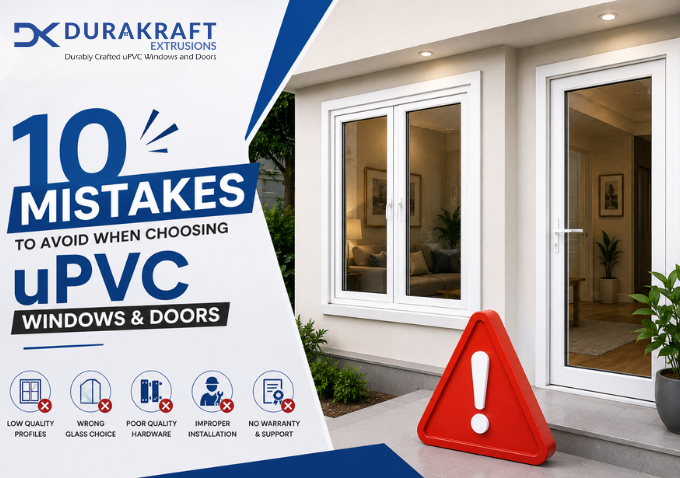
Avoid common buying mistakes such as ordering on price alone or skipping a site measurement. See our 10 mistakes to avoid when choosing uPVC windows and doors.
The profile determines how the window is assembled and how hardware, glass and seals fit. For mesh, it also affects whether there’s a track or mounting space for the screen.
At Durakraft Extrusions, window profiles are developed as systems. Sliding systems in the Premia Series (DK 50, DK 80 and DK 90) are used for sliding and casement applications, and our 2026 window designs guide notes mesh compatibility in applicable systems. Profile manufacturers, fabricators and mesh suppliers may be different parties. Ask your fabricator whether the screen fits the chosen frame, what extra tracks or space it needs, and how it is maintained.
Planning new windows with mosquito mesh? Talk to the Durakraft team
Not automatically. Some systems can be fitted with mesh, but it isn’t included with every window. Check the specification with your supplier.
It depends on your window. Sliding mesh suits compatible sliding windows, while casements and tilt & turn windows usually need fixed or removable screens. Fixed, pleated and roller systems suit different opening designs.
Often, the window design and available space decide which options fit. Have the frame checked before ordering.
No. It allows air to pass through, although airflow depends on the weave, material and screen size.
Not effectively. Mesh blocks insects, not fine dust or pollution.
No. Standard screens do not support weight. Ask about safety restrictors for upper floors or homes with children.
Brush or vacuum loose dust with a soft attachment, wash gently as the manufacturer advises, and keep sliding tracks free from debris.
Follow us on Instagram – Durakraft Extrusions
uPVC Windows with Mosquito Mesh: How They Work, Types and How to Choose
uPVC Profiles for High Rise Buildings: A Complete Guide
PVC vs uPVC Windows and Doors: Which Is Better for Your Home?
uPVC Window Security Features: How Secure Are Modern uPVC Windows?
uPVC Windows for Indian Weather: How to Choose the Right Window System
uPVC Windows vs Old Windows: When Should You Upgrade?
Top 10 uPVC Windows and Doors Profile Manufacturers in India
Best Modern uPVC Doors and Window Designs in 2026
uPVC vs Wood Windows and Doors: Why uPVC Is the More Practical Choice for Most Modern Homes
Copyright 2025 All Rights Reserved, Durakraft | Site Designed by CITEC