




CUSTOMER COMPLAINTS
We are sorry if we have caused any inconvenience to you. Please fill up the form below with your details. Our customer support staff will make sure we address your issue at the earliest.
Modern homes are no longer designed around appearance alone. Homeowners, architects, builders, and developers increasingly look for doors and windows that combine style, natural light, ventilation, security, durability, energy efficiency, and everyday comfort.This is where modern uPVC doors and window designs have become an important part of contemporary architecture.
In 2026, the focus is moving towards cleaner profiles, larger glass areas, practical opening styles, better insulation, and designs that connect indoor and outdoor spaces. From elegant casement windows to space-saving sliding systems and wide-opening fold & slide doors, there are more choices than ever for residential and commercial projects.
Durakraft offers a complete range of uPVC doors and window profile systems designed around different architectural requirements, including casement, sliding, tilt & turn, vertical sliding, French, and fold & slide configurations.
The best design depends on your space, ventilation requirements, opening size, architectural style, and budget.
Some of the most practical modern choices include:
The right choice is not simply the most attractive design. Profile engineering, reinforcement, glazing, hardware, sealing, installation, and the intended application all influence long-term performance.
Modern architecture is increasingly focused on creating brighter, more comfortable, and functional interiors.
A good door or window system can contribute to:
Durakraft’s website highlights features such as sound resistance, thermal insulation, weather resistance, low maintenance, corrosion resistance, termite resistance, durability, and customization across its profile solutions.
However, performance depends on the complete window or door assembly—not just the profile. The glass, reinforcement, hardware, seals, fabrication, and installation also matter.
Windows are one of the most visible elements of a building’s exterior and interior design. The best style depends on the room, available space, desired ventilation, and size of the opening.
Casement windows remain one of the most versatile choices for modern homes.
They are hinged and can open inward or outward depending on the configuration. Because they can provide a large open area, they are suitable for rooms where ventilation is an important consideration.
Casement windows also work well with contemporary architectural designs because their clean lines can complement both minimalist and traditional interiors.
Durakraft’s Premia range includes casement applications through its DK 50 system, which is designed for eco casement and sliding applications with a multi-chamber profile construction.
Sliding windows are among the most practical options for spaces where you want easy operation without requiring the shutters to swing into the room.
The panels move horizontally along tracks, making them useful where furniture, curtains, or other interior elements are positioned close to the window.
Durakraft’s Premia range includes DK 80 and DK 90 systems designed for wider and larger sliding applications. The DK 80 focuses on wider horizontal spans, while the DK 90 is positioned for larger openings and premium sliding requirements.
Tilt & turn windows are designed for flexibility.
They provide two opening functions:
Tilt:
The top portion opens inward for controlled ventilation.
Turn:
The entire sash opens inward for greater ventilation and access.
This makes tilt & turn windows particularly useful when you want ventilation without always opening the complete window.
Their multifunctional operation also makes them attractive for contemporary architectural projects where convenience and functionality are equally important.
Vertical sliding windows are a useful choice for spaces where the available opening is tall or where horizontal movement is not practical.
The sash moves vertically rather than horizontally.
This style can provide controlled ventilation while using the available wall space efficiently.
Durakraft includes vertical sliding windows in its product portfolio, giving architects and fabricators another option for different architectural requirements.
Fixed windows do not open, but they can play an important role in modern architecture.
They are particularly useful when the objective is to maximise:
Fixed windows can also be combined with opening windows to create larger window combinations.
For example, a large living-room elevation may combine fixed glazing with casement or sliding sections depending on ventilation requirements.
Modern architecture does not always require standard rectangular windows.
Durakraft’s Premia Series lists several window styles, including fixed, monorail, sliding, casement, tilt & turn, bay, arch, French, and full-circle windows.
These options can help architects and homeowners create more distinctive elevations.
Bay windows can project outward from the building and create additional visual depth.
Arch-shaped windows can add character to traditional, luxury, or statement elevations.
French-style windows can combine larger glass areas with an elegant appearance.
These are more decorative and can become a distinctive architectural feature where the building design allows them.
The important consideration is to choose unusual shapes because they genuinely suit the architecture—not simply because they look different.
Doors have a greater impact on movement, accessibility, security, and indoor-outdoor connection.
The right door design should therefore be selected according to opening size, traffic level, available space, glazing requirements, and architectural style.
Casement doors are a practical option for everyday entrances and access points.
They use a hinged opening mechanism and can be configured for different residential and commercial applications.
For a modern home, a glazed casement door can combine natural light with a clean architectural appearance.
Sliding doors are particularly useful when available floor space is limited.
Instead of swinging into or out of the room, the panels move horizontally along a track.
This makes them suitable for:
Durakraft’s Luxuria Series includes sliding door configurations and systems developed for different opening sizes. The range includes DK 60, DK 84, DK 94, and DK 108 systems.
For larger openings, the deeper DK 84, DK 94, and DK 108 systems are designed to support progressively larger panel configurations, subject to reinforcement, hardware, glazing, and project requirements.
French doors remain popular because they provide a combination of elegance and functionality.
Usually designed with two hinged panels, they can create a wider opening than a single conventional door.
Durakraft’s Luxuria door range supports French door configurations, including applications based around the DK 60 system.
French doors are especially useful when the architectural objective is to create a more traditional or premium appearance without moving away from modern uPVC profile technology.
Tilt & turn doors provide two operating functions similar to tilt & turn windows.
They can be tilted for controlled ventilation or opened more fully when access is required.
This makes them an interesting option for projects where ventilation and flexible operation are important.
They can be considered for:
The final suitability depends on the selected system, dimensions, glazing, reinforcement, and hardware.
Fold & slide doors are one of the most visually impressive options for large openings.
Instead of moving only one panel across another, multiple panels can slide and fold together.
This can create a significantly wider accessible opening and strengthen the visual connection between indoor and outdoor spaces.
Ideal applications include:
Durakraft’s Fold & Slide system includes features such as multi-point perimeter locking compatibility, tandem rollers, glazing options from 4 mm to 32 mm, and reinforced hardware configurations.
For modern homes with large openings, this style can provide a strong combination of aesthetics and functionality.
The biggest design trend is not one particular style. It is the movement towards cleaner aesthetics combined with better performance.
Large glazed openings can make interiors feel brighter and more connected to outdoor spaces.
Sliding and fold & slide systems are particularly useful for this purpose.
Modern architecture increasingly favours simple lines and uncluttered elevations.
Clean uPVC profiles can complement this design direction.
Homeowners increasingly want products that do more than simply open and close.
Tilt & turn systems, sliding systems, and fold & slide configurations offer different ways to control ventilation and access.
Modern profile systems are increasingly designed around insulation, weather resistance, sound reduction, and long-term durability.
Durakraft highlights thermal insulation, sound resistance, weather resistance, low maintenance, and durability among its product attributes.
Large sliding and folding door systems are becoming increasingly relevant for balconies, terraces, patios, gardens, and open-plan living spaces.
There is no single design that is best for every room.
| Area | Recommended uPVC Design | Why |
| Bedroom | Casement / Tilt & Turn | Ventilation and comfort |
| Living Room | Sliding / Fixed | Views and natural light |
| Kitchen | Casement / Vertical Sliding | Ventilation and practical operation |
| Balcony | Sliding Door / French Door | Space-efficient access |
| Garden | Fold & Slide / French Door | Wider connection |
| Study Room | Casement / Tilt & Turn | Controlled ventilation |
| Large Villa Opening | Sliding / Fold & Slide | Wide openings |
| Narrow Opening | Vertical Sliding | Efficient use of space |
The best solution should always be selected according to actual opening dimensions and structural requirements.
A beautiful design is only one part of a successful installation.
Before choosing a system, consider these factors.
Check the profile depth, chamber design, reinforcement compatibility, and intended application.
Multi-chamber profile construction can contribute to structural stability and insulation.
Larger windows and doors may require appropriate reinforcement to maintain stability.
This becomes especially important for large glass panels and wide door shutters.
Glass has a major influence on thermal performance, sound reduction, safety, and overall appearance.
Depending on the project, options may include:
Handles, hinges, rollers, locking mechanisms, and other hardware directly influence the operation and security of the finished product.
Good seals help control air and water infiltration and contribute to overall comfort.
Even a high-quality profile can underperform if it is fabricated or installed incorrectly.
Always work with experienced fabricators and installers who understand the selected system.
Durakraft’s Premia Series provides different window systems for varying applications.
The range includes:
The DK 50 system is designed for casement and sliding applications, while DK 80 is positioned for wider sliding applications. DK 90 is designed for larger sliding openings where greater structural stability is required.
The series also supports a broad range of styles, including fixed, sliding, casement, tilt & turn, bay, arch, French, and full-circle windows.
This allows fabricators and project designers to select configurations according to the opening and architectural requirement rather than relying on a single window style.
For door applications, Durakraft’s Luxuria Series includes DK 60, DK 84, DK 94, and DK 108 systems.
These systems support configurations such as:
The systems are designed with multi-chamber profiles and reinforcement options for different opening sizes and performance requirements.
For example, the DK 60 is intended for standard casement and French door applications, while deeper systems such as DK 84, DK 94, and DK 108 are designed for progressively larger openings. Actual allowable dimensions depend on reinforcement, hardware, glazing, and project conditions.
The visible design may attract attention, but the profile is the foundation of the finished product.
A quality profile should be evaluated for:
Durakraft states that its manufacturing process uses advanced extrusion technology, precision tooling, quality control, and premium-grade raw materials. The company also highlights its experience in uPVC window and door profile extrusion and its focus on supporting fabricators, builders, architects, and channel partners.
This manufacturer-level approach is important because the profile is only one part of the final window or door. Successful results depend on the complete system and how it is fabricated and installed.
Before finalising your design, ask these questions:
Small bedroom windows and large villa openings require different systems.
Casement and tilt & turn configurations can provide different ventilation options compared with fixed or sliding systems.
Sliding windows and doors can be useful when swing space is restricted.
Fold & slide systems can be considered when maximum accessibility is a priority.
French, arch, bay, full-circle, and large-format designs can create different architectural effects.
Consider heat, rain, dust, humidity, wind, and outdoor noise when selecting the complete system.
Ask who will fabricate and install the system and whether they are experienced with the selected profile configuration.
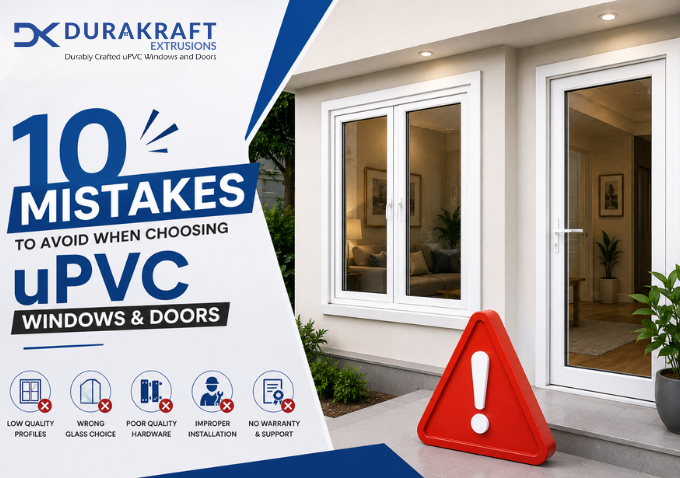
Common Mistakes to Avoid
A stylish window may not be the correct solution for your opening or ventilation requirement.
Profile depth, chambers, reinforcement, glazing compatibility, and hardware should be evaluated before purchase.
Large glass areas look attractive, but the profile, reinforcement, hardware, and glazing must be suitable for the dimensions.
Hardware affects operation, security, and long-term usability.
Poor installation can affect sealing, operation, drainage, and overall performance.
Different rooms have different requirements. A bedroom, kitchen, balcony, and large living-room opening do not necessarily need the same system.
Expert Insight: Design Should Follow Performance
A modern window or door should not be selected simply because it looks attractive in a catalogue.
At Durakraft Extrusions, the focus is on combining modern architectural design with engineered uPVC profile systems. The company’s portfolio covers multiple opening styles and system configurations so that fabricators, architects, builders, and project teams can select solutions according to application requirements.
The company’s website also highlights a focus on durability, precision, weather resistance, thermal insulation, sound resistance, low maintenance, and customization.
For a successful project, therefore, design, profile engineering, glazing, hardware, fabrication, and installation should be considered together.
Popular options include casement, sliding, tilt & turn, vertical sliding, French, fixed, and fold & slide designs. The best choice depends on the opening size, ventilation, space, architectural style, and performance requirements.
Casement, sliding, and tilt & turn windows are versatile options for modern homes. Sliding windows are useful where space is limited, while casement and tilt & turn systems can provide flexible ventilation.
Sliding doors and French doors are common choices for balconies. Sliding doors can save floor space, while French doors provide a more traditional double-opening appearance.
Neither is universally better. Sliding windows are useful for space-saving operation and wider horizontal openings, while casement windows can provide greater opening and ventilation depending on the configuration.
They can be a suitable option for large openings where homeowners want wider access between indoor and outdoor spaces. The final configuration should be selected based on opening dimensions, reinforcement, glazing, hardware, and structural requirements.
Check the profile construction, material quality, profile depth, reinforcement compatibility, glazing options, hardware, seals, drainage, fabrication quality, installation, and manufacturer support.
uPVC is generally considered a low-maintenance material. Regular cleaning of profiles, glass, drainage paths, tracks, and hardware helps maintain performance over time.
The best modern uPVC doors and window designs in 2026 are not defined by appearance alone.
A good system should balance:
For smaller openings, casement and tilt & turn uPVC windows can provide practical ventilation. Sliding windows are useful where space-saving operation is important. For larger openings, sliding and fold & slide doors can create a stronger connection between indoor and outdoor areas.
Durakraft’s product portfolio provides multiple window and door configurations, including casement, sliding, tilt & turn, vertical sliding, French, and fold & slide systems.
Modern architecture in 2026 is moving towards designs that combine clean aesthetics with practical performance.
Whether you are designing a new home, renovating an apartment, planning a villa, or working on a commercial project, choosing the right uPVC system requires more than comparing appearances.
Consider the opening size, room function, ventilation, available space, glazing, profile construction, reinforcement, hardware, weather conditions, and installation quality before making a decision.
From casement and sliding windows to tilt & turn, vertical sliding, French windows, sliding doors, casement doors, French doors, and fold & slide systems, modern uPVC solutions provide a wide range of possibilities for contemporary architecture.
With the right profile system and professional fabrication, your doors and windows can become more than architectural features—they can contribute to the comfort, functionality, durability, and visual character of the entire building.
Durakraft Extrusions Private Limited is a uPVC doors and window profile manufacturer focused on precision extrusion, modern system design, durability, and solutions for Indian architectural requirements.
Its product portfolio includes a range of uPVC doors and window systems designed for residential and commercial applications, supported by technical expertise and a B2B-focused approach for fabricators, builders, architects, and channel partners.
For projects requiring modern uPVC profile solutions, choosing the appropriate system based on application, dimensions, performance requirements, and fabrication conditions is the key to achieving long-term results.
Follow us on Instagram – Durakraft Extrusions
uPVC Windows vs Old Windows: When Should You Upgrade?
Top 10 uPVC Windows and Doors Profile Manufacturers in India
Best Modern uPVC Doors and Window Designs in 2026
uPVC vs Wood Windows and Doors: Why uPVC Is the More Practical Choice for Most Modern Homes
10 Mistakes to Avoid When Choosing uPVC Windows and Doors
uPVC Building Materials: A Complete Guide to Modern Home Solutions
Best uPVC Windows and Doors in India: How to Choose the Right Manufacturer
uPVC Frames Buying Guide: How to Choose the Right uPVC Window and Door Frames
How to Choose the Best uPVC Door and Window for Your Home
How to Choose the Right Sound Resistant uPVC Windows and Frames
Copyright 2025 All Rights Reserved, Durakraft | Site Designed by CITEC