




CUSTOMER COMPLAINTS
We are sorry if we have caused any inconvenience to you. Please fill up the form below with your details. Our customer support staff will make sure we address your issue at the earliest.
Introduction
When people build or renovate a home, they usually think about flooring, paint, furniture, and interiors first. But some of the most important decisions are made around the uPVC building materials used for doors, windows, frames, and other openings.
This is where uPVC building materials have become an increasingly popular choice. They combine durability, low maintenance, insulation, weather resistance, and modern design — making them suitable for both new construction and renovation projects.
From windows and doors to frames and profile systems, uPVC can be used across several areas of modern construction. The right system can improve indoor comfort, reduce maintenance requirements, and provide dependable performance over many years.
At Durakraft Extrusions, we focus on manufacturing uPVC profile solutions designed for modern Indian construction requirements. Our approach combines precision extrusion, practical engineering, and a clear understanding of the performance expected from window and door systems.
This guide explains what uPVC building materials are, where they’re used, their main benefits, and what to consider before choosing them for your home.
uPVC building materials are construction products made using unplasticized polyvinyl chloride. They’re commonly used for window and door profiles, frames, and related building systems.
They’re popular because they offer:
That said, actual performance depends on the profile design, glazing, hardware, fabrication, installation, and overall system quality — not the material alone.
uPVC stands for unplasticized polyvinyl chloride. Unlike flexible PVC products, uPVC is manufactured without added plasticizers, which gives it the rigidity needed for applications such as window and door profiles.
Because of this, the material is valued in construction for offering a combination of structural stability, weather resistance, insulation, and low maintenance — all in one system.
Modern uPVC profiles can be engineered with multiple internal chambers — the hollow sections running through the profile that trap air and improve insulation. These chambers help manufacturers design profiles suited to different window and door configurations.
Homeowners today expect more from their building materials. A product needs to look good, perform reliably, and stay easy to maintain — and that combination has driven growing interest in uPVC home solutions.
One of the biggest advantages of uPVC is how little upkeep it needs. Unlike traditional wooden frames, uPVC typically doesn’t require regular painting, polishing, or anti-termite treatment. Routine cleaning with a soft cloth and a mild cleaning solution is generally enough.
Windows and doors face constant outdoor exposure. Quality uPVC profiles can resist moisture, rain, humidity, corrosion, termites, and everyday environmental wear — making them suitable across many climates.
That said, the performance of the complete system still depends on proper fabrication, sealing, drainage, hardware, and installation, not the profile material alone.
Windows and doors influence how much heat enters or leaves a building. uPVC profiles have relatively low thermal conductivity compared with many conventional frame materials, and multi-chamber designs can further improve insulation. Paired with the right glazing and sealing, a complete system can meaningfully improve indoor thermal comfort.
Noise is another real concern for modern homes, especially in urban areas. A well-designed window system can reduce outside noise through a combination of profile design, airtight sealing, suitable glazing, quality gaskets, and correct installation. It’s worth remembering: the frame alone doesn’t determine acoustic performance — the complete window assembly does.
The term “uPVC building materials” covers more than one product — different profile systems are designed for different applications.
Casement Windows — Hinged at the side, opening inward or outward. Popular for good ventilation, wide openings, effective sealing, and simple operation. Common in bedrooms, living rooms, kitchens, and offices.
Sliding Windows — Move horizontally along tracks. Useful where external opening space is limited, commonly seen in apartments, balconies, and modern residential projects.
Tilt and Turn Windows — Offer two operating positions: tilt inward for controlled ventilation, or open inward fully for greater airflow and access. Particularly useful where ventilation flexibility and easy cleaning matter.
Fixed Windows — Don’t open; their main purpose is natural light and views. Often combined with operable windows to create larger glazed areas.
Casement Doors — Hinged doors commonly used for balconies, patios, and gardens.
Sliding Doors — Move horizontally, useful for balconies and spaces where a swinging door would need extra clearance.
French Doors — Feature large glazed areas, often chosen for natural light and a traditional, elegant look.
Slide and Fold Doors — Interconnected panels that slide and fold to one side, suited to large openings where homeowners want a strong indoor-outdoor connection.
A good building material should solve practical problems, not just look attractive. Modern uPVC solutions contribute to several aspects of residential performance:
| Feature | uPVC | Wood | Aluminium |
| Thermal Insulation | 🏆 Superior insulation with low heat transfer | Good natural insulation | Lower without thermal break |
| Sound Insulation | 🏆 Better noise reduction potential | Good | Moderate to good, depending on system |
| Maintenance | 🏆 Very low – simple cleaning is usually sufficient | Higher – requires painting, polishing and protection | Low, but finishes may require care |
| Moisture & Corrosion Resistance | 🏆 Highly resistant to moisture, rust and corrosion | Can absorb moisture and deteriorate without protection | Resistant to moisture but may corrode in certain conditions |
| Durability | 🏆 Long-lasting with strong resistance to weathering and termites | Requires regular treatment and protection | Durable but performance depends on finish and environment |
| Cost & Long-Term Value | 🏆 Cost-effective with low maintenance and strong insulation | Higher upkeep over time | Generally higher initial cost |
The actual performance of any material still depends on product quality, design, fabrication, installation, and application — the table above is a starting point, not the final word.
Not every product on the market performs the same way. Before purchasing, look at the complete system:
At Durakraft Extrusions, we believe choosing a uPVC product should start with the application, not the appearance alone.
For example, a small bedroom window and a large balcony door have very different structural and operational requirements. Profile configuration, glazing, hardware, reinforcement, sealing, and installation all need to be considered together.
This complete-system approach helps architects, builders, fabricators, and homeowners make more informed decisions — instead of choosing a product simply because it looks attractive or carries a lower upfront price.
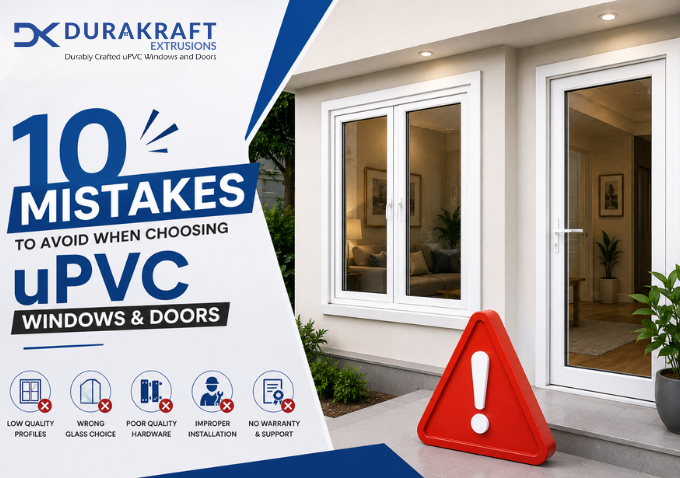
Choosing only by price — the cheapest option may not offer the best long-term value. Compare profile quality, system design, hardware, installation, warranty, and expected service life.
Ignoring installation — incorrect installation can cause air leakage, water infiltration, operational problems, and reduced insulation.
Focusing only on the frame — glass, seals, hardware, fabrication, and installation all shape final performance just as much as the frame itself.
Choosing a system without considering the application — a sliding window, casement window, and large folding door each have different requirements. Choose based on opening size, ventilation needs, usage, and architectural design.
| Myth | Fact |
| All uPVC profiles perform the same way. | Profile design, material quality, manufacturing, and system configuration can all vary significantly. |
| uPVC is only suitable for budget homes. | uPVC systems are used in apartments, villas, premium homes, offices, hotels, and commercial projects alike. |
| uPVC requires frequent painting. | Good-quality uPVC generally needs routine cleaning, not regular painting. |
| Glass alone determines window performance. | The complete system — frame, glazing, seals, hardware, fabrication, and installation — determines performance. |
One reason homeowners choose uPVC is its simple maintenance routine:
Regular inspection is especially useful for doors and windows that see frequent daily use.
For many homeowners, uPVC is a practical choice when durability, low maintenance, insulation, and modern design are priorities. That said, the right solution still depends on your specific project.
Before deciding, work through this chain:
Location → Climate → Opening size → Window/door style → Glazing → Hardware → Installation → Budget
Looking at these factors together — rather than picking the most popular product — will help you choose a system that’s actually right for your home.
uPVC building materials are construction products made from unplasticized polyvinyl chloride, commonly used for window and door profiles, frames, and related building systems.
They offer low maintenance, good weather resistance, thermal insulation, durability, and a wide range of design options.
Yes. Properly designed and installed uPVC window systems can suit different Indian climatic conditions — the profile, glazing, sealing, and installation should be matched to the local environment.
Quality uPVC door systems are built for regular daily use. Durability depends on profile quality, hardware, fabrication, installation, and ongoing maintenance.
No. Routine cleaning and periodic inspection of seals, tracks, and hardware are generally all that’s needed.
Yes. uPVC profiles have good insulating characteristics, and when combined with suitable glazing and sealing, they can meaningfully improve thermal performance.
A profile is the component used to manufacture the window or door frame. A complete window includes the profile along with glazing, hardware, seals, and other components.
Start with your application’s requirements — opening size, window or door style, climate, glazing, ventilation, security, insulation, hardware, and installation quality all matter.
Looking for reliable uPVC profile solutions for your home or project? Our team can help you choose the right system for your application, climate, and budget.
Our Address : Durakraft Extrusions Private Limited D-22, Site III, Meerut Road Industrial Area, Near Ram Chameli Chada Girls College, Ghaziabad, Uttar Pradesh 201003
Email info@durakraft.in
Call Us +91-1800 4123 1997
Follow us on Instagram – Durakraft Extrusions
uPVC Windows with Mosquito Mesh: How They Work, Types and How to Choose
uPVC Profiles for High Rise Buildings: A Complete Guide
PVC vs uPVC Windows and Doors: Which Is Better for Your Home?
uPVC Window Security Features: How Secure Are Modern uPVC Windows?
uPVC Windows for Indian Weather: How to Choose the Right Window System
uPVC Windows vs Old Windows: When Should You Upgrade?
Top 10 uPVC Windows and Doors Profile Manufacturers in India
Best Modern uPVC Doors and Window Designs in 2026
uPVC vs Wood Windows and Doors: Why uPVC Is the More Practical Choice for Most Modern Homes
Copyright 2025 All Rights Reserved, Durakraft | Site Designed by CITEC